
What Is a Crypto ASIC Miner and How Does It Work?
A Crypto Asic Miner is a purpose-built machine designed to solve cryptographic puzzles efficiently. Unlike a general-purpose computer, it uses application-specific integrated circuits to perform one task: hashing. For Bitcoin, these chips repeatedly calculate SHA-256 hashes while changing a small value called a nonce. The goal is simple. Find a valid hash before competing miners do.
The physical process is less mysterious than it sounds. A miner receives pending transactions through a mining pool, tests trillions of possible hashes, and reports successful work to the pool. If the network accepts a block, rewards are distributed according to the pool’s rules. Bitcoin’s difficulty adjusts regularly, so faster hardware does not guarantee higher profits. Electricity prices, machine efficiency, cooling, pool fees, and Bitcoin’s market price matter just as much.
The scale is substantial. The International Energy Agency estimated global cryptocurrency mining consumed about 110 terawatt-hours in 2022. Cambridge Centre for Alternative Finance also tracks Bitcoin’s electricity demand through its Bitcoin Electricity Consumption Index, showing why energy estimates deserve careful interpretation. Industry figures can differ. The Bitcoin Mining Council reported that sustainable electricity represented 59.9% of surveyed Bitcoin mining energy in its fourth-quarter 2023 survey, but its sample was self-reported. That limitation matters.
A miner is not magic.
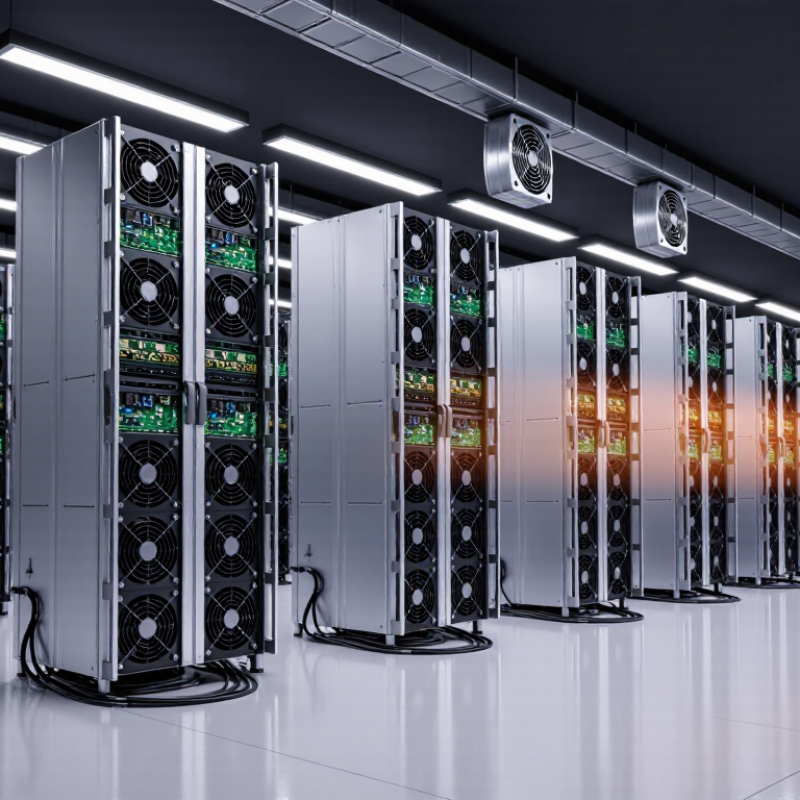
Inside a noisy data center, hundreds of machines produce heat while fans push warm air through narrow aisles. This article examines how Crypto Asic Miner hardware works, why its efficiency is measured in joules per terahash, and where popular explanations become incomplete. The technology is powerful, but the economics remain fragile and worth questioning.
What Is a Crypto ASIC Miner?
A crypto ASIC miner is a specialized computer built to solve one type of cryptographic calculation. ASIC means application-specific integrated circuit. Unlike a general-purpose computer, it uses chips designed for repeated hashing. The miner receives a block header, changes a small value called a nonce, and tests the result against the network’s difficulty target. When it finds a valid hash, it broadcasts the result for verification.
This process demands steady electricity and produces noticeable heat. A typical unit contains hashing boards, cooling fans, a controller, and a network connection. Its performance is measured in hashes per second, while efficiency is measured by electricity used for each hash. Higher speed does not always mean better results. Power prices, operating temperature, noise, network difficulty, and hardware reliability all affect actual returns. ASICs are powerful, but they are not flexible. A model designed for one algorithm may become useless for another. That limitation is easy to underestimate.
Tips: Check the device’s power draw before buying. Measure the outlet, not just the machine. Keep airflow clear and monitor heat continuously. Compare realistic electricity costs with current network conditions. Profit estimates can look precise, yet they change quickly. Also, avoid sealed or poorly ventilated spaces. Small mistakes here can shorten hardware life. I would treat every forecast as uncertain, because difficulty and market prices can move together in unpleasant ways.
What Is a Crypto ASIC Miner and How Does It Work?
| Data Dimension | Typical Data or Range | How It Works or Why It Matters |
|---|---|---|
| Definition | Application-Specific Integrated Circuit miner | A specialized computer designed to perform one cryptographic mining algorithm much more efficiently than general-purpose hardware. |
| Primary Function | Repeatedly calculate cryptographic hashes | The miner changes a variable called a nonce and hashes the candidate block until the result satisfies the network difficulty target. |
| Supported Algorithm | One designated algorithm, such as SHA-256 or Scrypt | An ASIC built for one algorithm generally cannot efficiently mine networks that use a different algorithm. |
| Hashrate Measurement | Hashes per second; common units include TH/s and GH/s | For SHA-256 mining, modern single-unit performance is commonly measured in tens or hundreds of terahashes per second. |
| Typical SHA-256 Hashrate | Approximately 100–250 TH/s for many current-generation units | Actual performance depends on chip design, operating temperature, firmware settings, and power mode. |
| Electrical Power Draw | Approximately 2.5–4.0 kW per high-performance SHA-256 unit | Power consumption is continuous during operation and is a major factor in mining profitability and infrastructure planning. |
| Energy Efficiency | Approximately 15–30 joules per terahash (J/TH) | Lower J/TH means less electricity is required to produce the same amount of hashing work. |
| Daily Electricity Use | About 60–96 kWh per day at 2.5–4.0 kW continuous load | The estimate is calculated as power draw in kilowatts multiplied by 24 hours. |
| Heat Generation | Nearly equal to electrical power consumed | A miner drawing 3.5 kW ultimately releases roughly 3.5 kW of heat, requiring suitable ventilation or cooling. |
| Operating Noise | Commonly about 60–80 dBA | High-speed fans remove heat from the hashing boards, making many ASIC miners unsuitable for quiet residential spaces. |
| Core Components | Hashing boards, control board, power supply, cooling fans, and enclosure | The hashing boards perform calculations, while the control board manages networking, mining software, and configuration. |
| Mining Workflow | Receive work → construct a candidate block → test nonces → submit valid results | The ASIC performs the hashing loop while a node or mining pool supplies job data and verifies submitted shares. |
| Mining Pool Connection | Commonly uses the Stratum protocol over a network connection | Pools divide work among miners and provide more frequent, smaller payouts than independent mining. |
| Probability of Finding a Block | Proportional to the miner’s share of total network hashrate | Higher hashrate increases expected success over time, but individual block discovery remains probabilistic. |
| Main Revenue Factors | Mining rewards, transaction fees, network difficulty, coin price, and electricity cost | Profitability changes continuously as network conditions, market prices, and operating costs change. |
| Key Limitation | Limited flexibility and rapid technological obsolescence | An ASIC may lose competitiveness when newer, more efficient hardware raises the network’s total hashrate and difficulty. |
Related Posts
-
How to Choose the Best Crypto Mining Asic for Your Needs?
-
Unleashing Excellence in Global Supply Chains with China's Best Asic Crypto Miner Solutions
-

Top 10 Bitcoin Containers for Global Importers Today?
-
5 Reasons Why the Best Antminer Container is Essential for Your Mining Success
-
Revolutionizing Cryptocurrency Mining with Best Crypto Asic Miner and Its Industry Challenges
-

Exploring Alternative Crypto Miners for Sale: Comparing Efficiency and Cost-Effectiveness in 2023